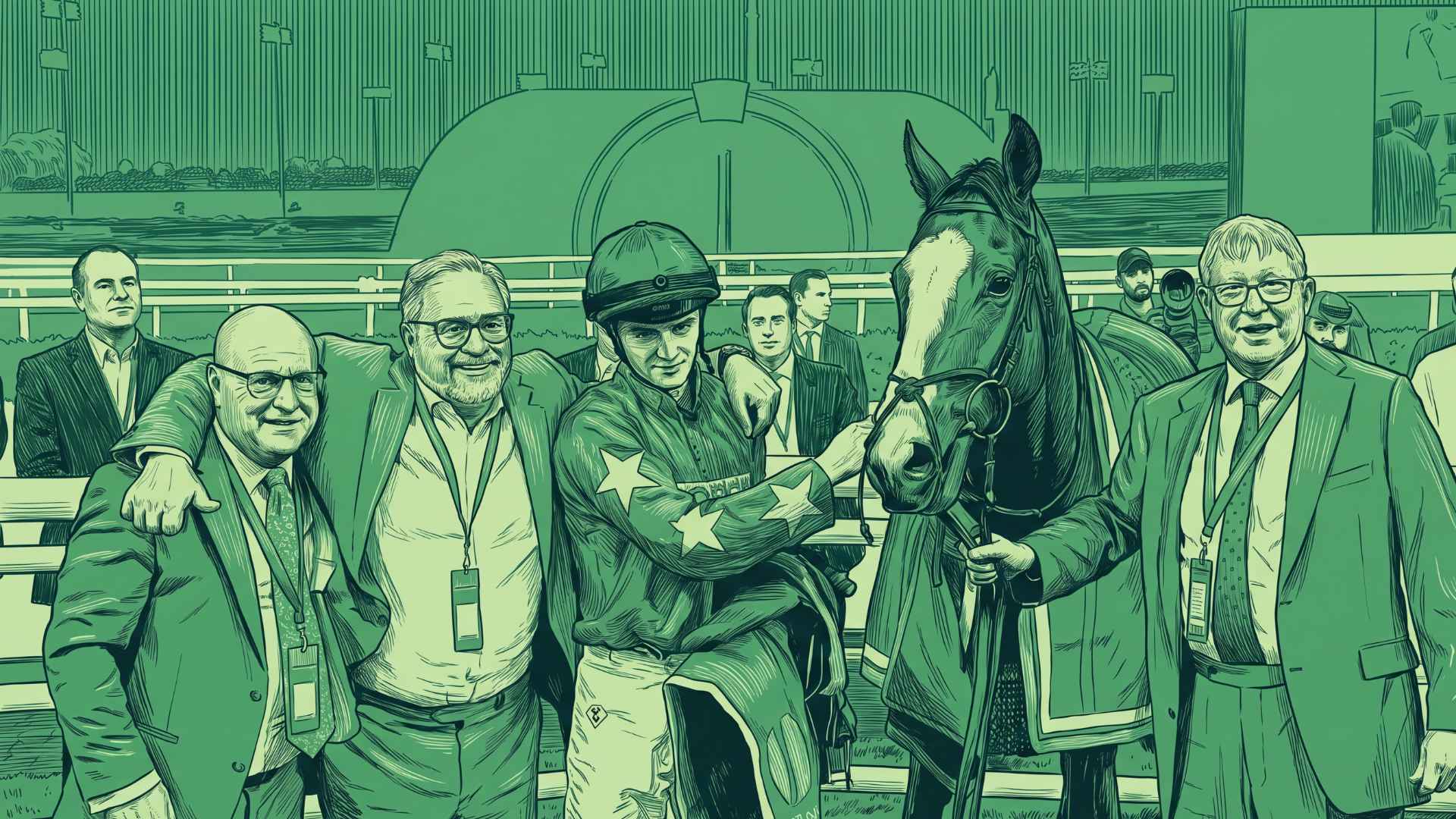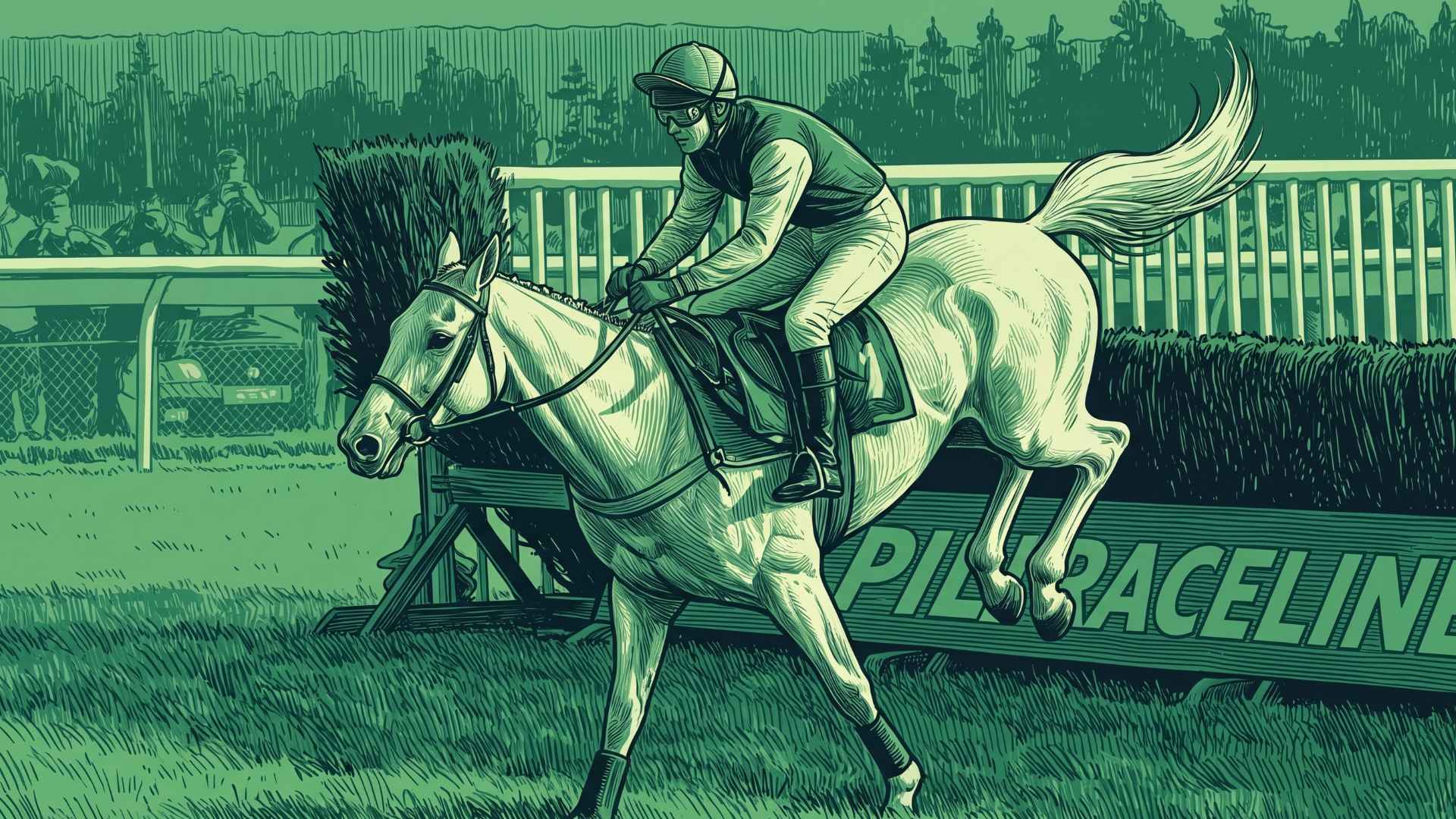

There was a time when a grey horse could bring an entire racecourse to its feet simply by appearing in the paddock.
Desert Orchid had that effect on people. Known affectionately as Dessie, his near-white coat, bold jumping and unmistakable personality made him one of Britain’s best-loved sporting figures.
He had his quirks, too. He preferred right-handed tracks, disliked heavy ground and wasn’t always the easiest ride. But when everything clicked, particularly at Kempton, he was magnificent.
His 34 victories included four King George VI Chases, a Cheltenham Gold Cup and an Irish Grand National. Yet his place in racing history owes as much to the affection he inspired as the races he won.
When he died in 2006, his ashes were buried at Kempton, where he had enjoyed some of his greatest triumphs. It was a fitting resting place for a horse who had become such a familiar part of British racing.
The story of how Dessie became that horse was rather less straightforward.
David Elsworth and a Grey With a Mind of His Own
Foaled on 11 April 1979, Desert Orchid was bred by James Burridge, a son of Grey Mirage out of the mare Flower Child. He would spend his entire racing career with David Elsworth, whose Whitsbury Manor yard in Hampshire was home to an unusually varied collection of talent.
Elsworth was a gifted trainer with little interest in convention for its own sake. He enjoyed horses with character, which was fortunate because Desert Orchid had plenty.
The young grey was not an obvious candidate for greatness. His coat was darker than the almost white colouring for which he became famous, and his first appearance on a racecourse suggested that his career might be over before it had properly begun.
Making his debut over hurdles at Kempton in 1983, Desert Orchid fell heavily at the final flight and remained on the ground for an alarming length of time. Screens were erected around him as those watching feared the worst.
Eventually, he got to his feet.
It was a dreadful introduction to racing, but one from which he recovered sufficiently to develop into a talented hurdler. Under Colin Brown, who would become an important figure in his career, Desert Orchid won the Tolworth Hurdle and Kingwell Hurdle in 1984. He even contested the Champion Hurdle, although Dawn Run proved far too good for him.
There was speed in abundance, but Desert Orchid was not quite the finished article. He could be headstrong, and his jumping required attention. Once switched to fences, however, the qualities that would make him famous began to emerge.
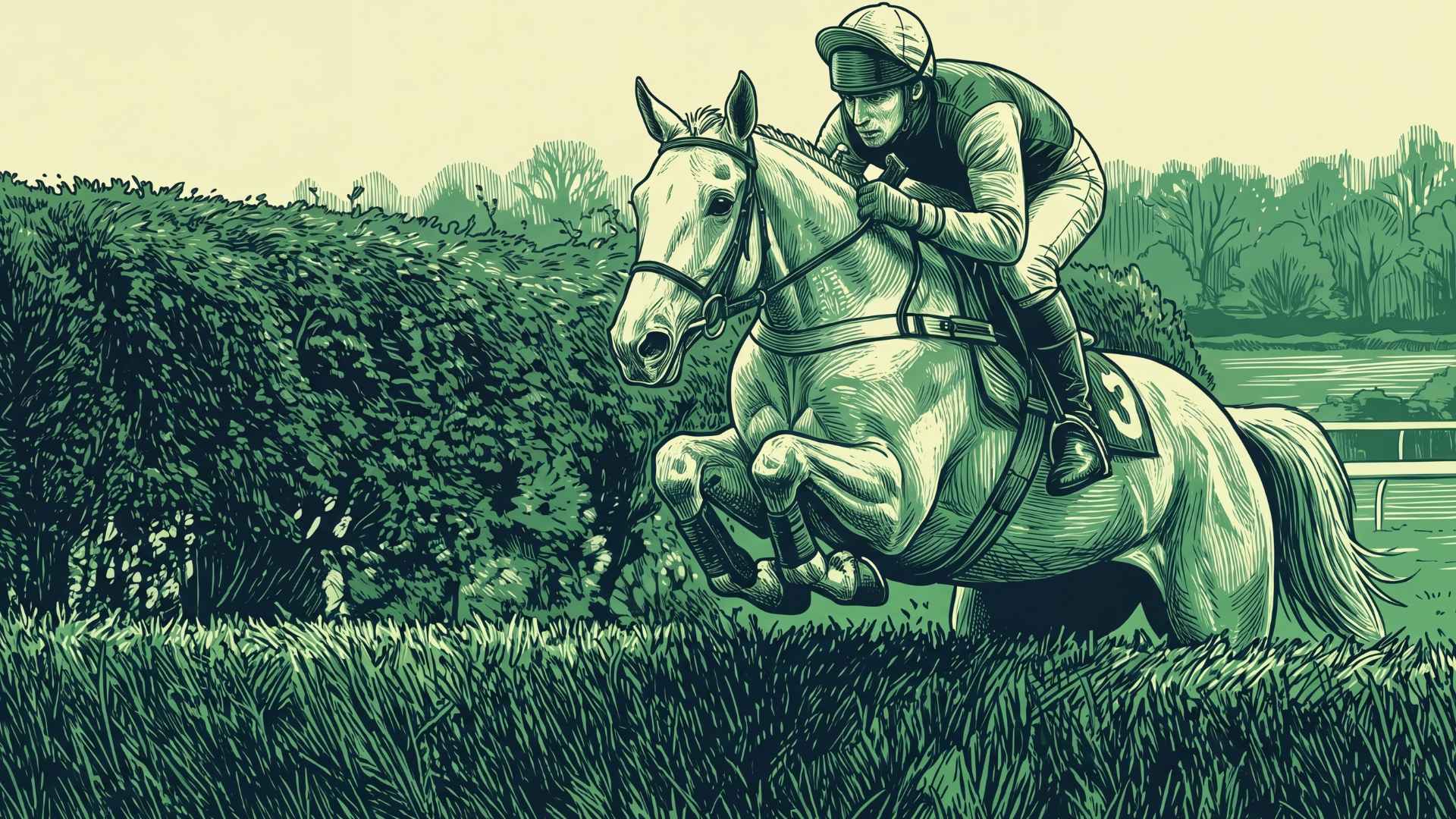
Rather than being restrained behind other horses, Desert Orchid was happiest bowling along, attacking his fences and forcing the opposition to keep up. When he found his rhythm, he could make accomplished chasers look distinctly ordinary.
His preference for right-handed tracks was equally apparent. Desert Orchid tended to jump to his right, something that could prove costly when racing in the opposite direction. Kempton, with its right-handed configuration and relatively flat nature, suited him beautifully. It would become his favourite stage.
Desert Orchid and the King George VI Chase
Few horses have been as closely associated with a particular race as Desert Orchid was with the King George VI Chase.
His first victory, in 1986, was hardly anticipated. Until then, Desert Orchid had been regarded largely as a two-mile specialist. Asking him to tackle three miles against established staying chasers was a considerable change, and even his regular jockey Colin Brown preferred the claims of stablemate Combs Ditch.
Simon Sherwood took the ride instead.
Desert Orchid was sent off at 16/1, but there was nothing fortunate about what followed. He took the race apart, jumping boldly and galloping relentlessly to win by 15 lengths.
Suddenly, the speedy grey who had looked so effective over shorter distances was a genuine staying chaser. Better still, he appeared to have found a racecourse that allowed him to express himself without compromise.
Kempton brought out the best in him, and the public soon recognised it. The Boxing Day crowds came to expect a familiar sight: Desert Orchid travelling prominently, his grey coat standing out against the winter surroundings, daring the others to catch him.
He was beaten into second in 1987, but returned to win in 1988, 1989 and 1990. Four King Georges in five years was an extraordinary achievement, eventually surpassed only by Kauto Star.
Yet concentrating solely on Kempton rather undersells him. Desert Orchid could be devastating over two miles, as his Tingle Creek Chase victory demonstrated, but he also possessed the stamina to win the Whitbread Gold Cup over a considerably longer trip at Sandown.
And when the handicapper tried to bring him back to the opposition, he could still find a way. At Ascot in 1989, he conceded 22lb to Panto Prince in the Victor Chandler Chase and prevailed by a head.
It was a proper battle, the sort that endeared him to racing followers who appreciated a horse prepared to fight for every yard. Desert Orchid was never particularly interested in making things look easy, and that willingness to keep responding under pressure would produce his most famous victory only weeks later.
The 1989 Cheltenham Gold Cup: Dessie’s Finest Hour
The 1989 Cheltenham Gold Cup presented Desert Orchid with almost everything he disliked.
Cheltenham was left-handed, for a start. His tendency to jump right meant he could lose valuable ground around the course, and there was little opportunity to settle into the comfortable rhythm he enjoyed at Kempton.
Heavy rain and snow had also left the racecourse in dreadful condition. The ground was thoroughly testing, and Desert Orchid had never been particularly enthusiastic about ploughing through mud.
David Elsworth nevertheless sent him to Cheltenham, where he started the Gold Cup as the 5/2 favourite. Simon Sherwood was back in the saddle, but this would be nothing like the free-flowing performances they had enjoyed at Kempton.
The race became a severe examination of stamina. Horses struggled in the conditions, jumping errors became increasingly costly, and several leading contenders failed to complete. Ten Plus, travelling strongly at the time, suffered a fatal injury when falling at the third-last fence. It was a sombre moment in an already gruelling contest.
Desert Orchid inherited the lead, but he was finding the ground increasingly difficult. Yahoo, who was much happier in the mud, began to close and eventually moved past him.
The grey looked beaten.
There was no spectacular change of gear, no sudden burst of speed. Desert Orchid simply refused to stop trying.
Sherwood continued asking, and gradually the response came. As they approached the final fence, Yahoo still held the advantage, but Desert Orchid was beginning to close. Then came the climb towards the winning post.
The familiar grey, exhausted and thoroughly out of his comfort zone, somehow found enough to overhaul Yahoo and win by a length and a half.
The Cheltenham crowd erupted.
It was not the most fluent performance of Desert Orchid’s career, nor the easiest on the eye. But it was probably the one that told racing followers most about him. He had won on a left-handed course, in ground he disliked, after appearing to have nothing left to give.
Sir Peter O’Sullevan’s commentary provided the perfect accompaniment: “Dessie has done it!”
The victory became one of the defining moments in modern National Hunt racing. In 2005, readers of the Racing Postvoted the contest the greatest race of all time. For Desert Orchid, it was the afternoon when his popularity reached another level.
Twelve Stone and the Irish Grand National
A horse could have retired after that Gold Cup and been remembered as a great champion. Desert Orchid was not finished.
The following season brought another King George, along with further evidence that the handicapper was struggling to find a weight capable of bringing him back to ordinary company. At Kempton in February 1990, he carried 12st 3lb to victory in the Racing Post Chase, conceding two stone to the runner-up Delius.
He returned to Cheltenham the following month but could manage only third behind Norton’s Coin in the Gold Cup. Then came a decision that would add another famous chapter to his career.
Elsworth sent Desert Orchid to Fairyhouse for the Irish Grand National, a demanding staying handicap in which the grey was required to shoulder 12st.
He was now 11 years old, with years of hard racing behind him. The distance was three miles and five furlongs, and every rival was receiving at least 26lb.
Richard Dunwoody took the ride, and the pair produced a performance that was almost absurdly good. Desert Orchid travelled with enthusiasm, jumped well for much of the contest and, despite making a mistake at the final fence, drew clear to win by 12 lengths.
Here was a horse who could win a championship race over two miles, dominate the King George over three and then carry top weight to victory in one of the toughest staying handicaps on the calendar.
He was difficult to categorise, which was precisely why he was so good.
Desert Orchid’s Final Race
Desert Orchid continued racing after his Irish Grand National triumph, but by December 1991, the years were beginning to show. Now 12, he returned to Kempton on Boxing Day, hoping to add a fifth King George VI Chase to his record.
It wasn’t to be. Desert Orchid was struggling when he fell at the third-last fence. Thankfully, he escaped injury, and as he made his way back along the course, the Kempton crowd rose to applaud him. They couldn’t have known for certain it was his final appearance, but the reception was fitting for a horse who had given them so many memorable afternoons.
Connections decided the time had come to retire him. There was something unfortunate about Kempton providing both the beginning and end of his career, each marked by a heavy fall. Between those two afternoons, though, he had given the racecourse some of its finest moments.
Knowing when to call time is a difficult decision for any racehorse owner or syndicate. Some horses lose their enthusiasm, others struggle with the physical demands of racing, but ultimately their welfare must come first.
What happens afterwards matters too. Some retired racehorses find second careers in other equestrian disciplines, while others enjoy a quieter life. For syndicate members, understanding who takes responsibility for a horse’s retirement is an important part of ownership.
Desert Orchid’s Owners and the £100 Share
For all his fame, Desert Orchid’s ownership began on a surprisingly modest scale. Bred by James Burridge, he raced for a small partnership involving the Burridge family and Simon Bullimore, a lawyer whose interests lay rather more in sailing than horse racing.
Bullimore reportedly paid just £100 for a quarter share in Desert Orchid as a foal. He knew little about racing at the time, and could scarcely have imagined what his investment would eventually bring.
By the time Dessie retired, he had earned £654,066 in prize money, an enormous sum for a National Hunt horse of his generation. Of course, that wasn’t pure profit. Training fees, veterinary bills, jockeys’ percentages and other expenses all had to be accounted for, while the prize money was divided between the relevant connections.
The arrangement wasn’t a racing syndicate in the modern commercial sense, but it demonstrated the appeal of shared racehorse ownership long before syndicates became such a familiar part of the sport. Several people had a stake in the same horse, sharing the expense and enjoying the considerable rewards when things went well.
Bullimore was never particularly interested in the attention that came with owning a celebrity racehorse. He preferred to enjoy the big occasions without making himself the centre of them.
For £100, he had acquired a quarter share in one of the greatest steeplechasers Britain has ever seen. There cannot have been many better purchases in racing.
The People’s Champion, Long After the Racing Stopped
Desert Orchid’s popularity was never confined to racing followers. By the end of the 1980s, Dessie was a household name, attracting people who might otherwise have had little reason to visit a racecourse.
He had his own fan club, received thousands of Christmas cards and was regularly sent carrots, apples and polo mints. There was something wonderfully British about it all. One of the finest steeplechasers in training had admirers seemingly as concerned about his Christmas presents as his next race.
When Desert Orchid retired following the 1991 King George at Kempton, his racing days were over, but the public had little intention of saying goodbye.
He became a familiar guest at race meetings, agricultural shows and charity events, raising substantial sums for good causes. Even Lester Piggott, whose career had been spent among the finest Flat horses, rode Dessie during a parade.
Retirement was not entirely uneventful. A serious bout of colic required emergency surgery, but he recovered and continued enjoying life around David Elsworth’s stable, occasionally leading younger horses on the gallops.
Desert Orchid died on 13 November 2006, aged 27. His ashes were buried at Kempton Park, where a statue stands in his honour and the Desert Orchid Chase carries his name.
Racing has produced outstanding champions since Dessie’s time, but few have become such familiar figures outside the sport. For those who followed him, the memories are of a grey horse with his ears pricked, bowling along towards another fence, apparently enjoying himself every bit as much as the thousands watching.
Long after the victories, records and prize money, people still remember him simply as Dessie.