


At just 22 years old, Seina Imamura has already experienced more highs and lows than most jockeys face.
She arrived in Japanese racing as a teenager, rode 51 winners in her first season and won a graded race on her very first attempt at that level. Two years later, her annual winner total had fallen to six after a suspension and a serious shoulder injury that required surgery.
Then, in May 2026, came the result that changed the way her career would be remembered.
Imamura rode Juryoku Pierrot to victory in the Japanese Oaks at Tokyo, becoming the first Japanese woman to win a JRA Grade 1 race.
Racing Was Already in the Family
Seina Imamura was born in Shiga Prefecture on November 28, 2003, and racing was already part of family life.
Her father, Yasunari Imamura, had been a jockey and won the 2001 Nakayama Daishogai aboard Yufu Yoho before later working as a training assistant.
One horse in particular helped spark Seina’s interest. Her father worked with Meisho Mambo, who won the Japanese Oaks in 2013. Imamura later spoke about how much that victory meant to the people around the horse.
She began riding while still at primary school and took part in pony racing. Her mother supported her wish to become a jockey, although her father initially needed more convincing. Having worked in racing himself, he knew how tough the profession could be.
Second Place Wasn’t Good Enough
Imamura entered the JRA Racing School in 2019 at the age of 15. There were 110 applicants and only nine were accepted, with Imamura the only girl in the group.
One of her main rivals was Taiga Tsunoda, a friend who regularly finished above her in riding tests. Imamura did not enjoy coming second, and she liked even less the idea that finishing behind the boys should somehow count as a success.
“I really dislike being judged through the lens of being a girl,” she said in an interview.
That attitude followed her into professional racing. She wanted to be judged on her results, not given extra credit because she was female.
51 Winners in Her First Season
Imamura made her professional debut at Hanshin in March 2022 and rode her first winner just eight days later aboard Bravio.
Her major breakthrough came in July when she partnered T M Spada in the Grade 3 CBC Sho at Kokura.
It was Imamura’s first ride in a JRA graded race, and she won it.
T M Spada covered the 1,200 metres in 1 minute 5.8 seconds, setting a Japanese record. Imamura also became only the fourth rookie since Japan introduced its grading system in 1984 to win on a first graded-race ride.
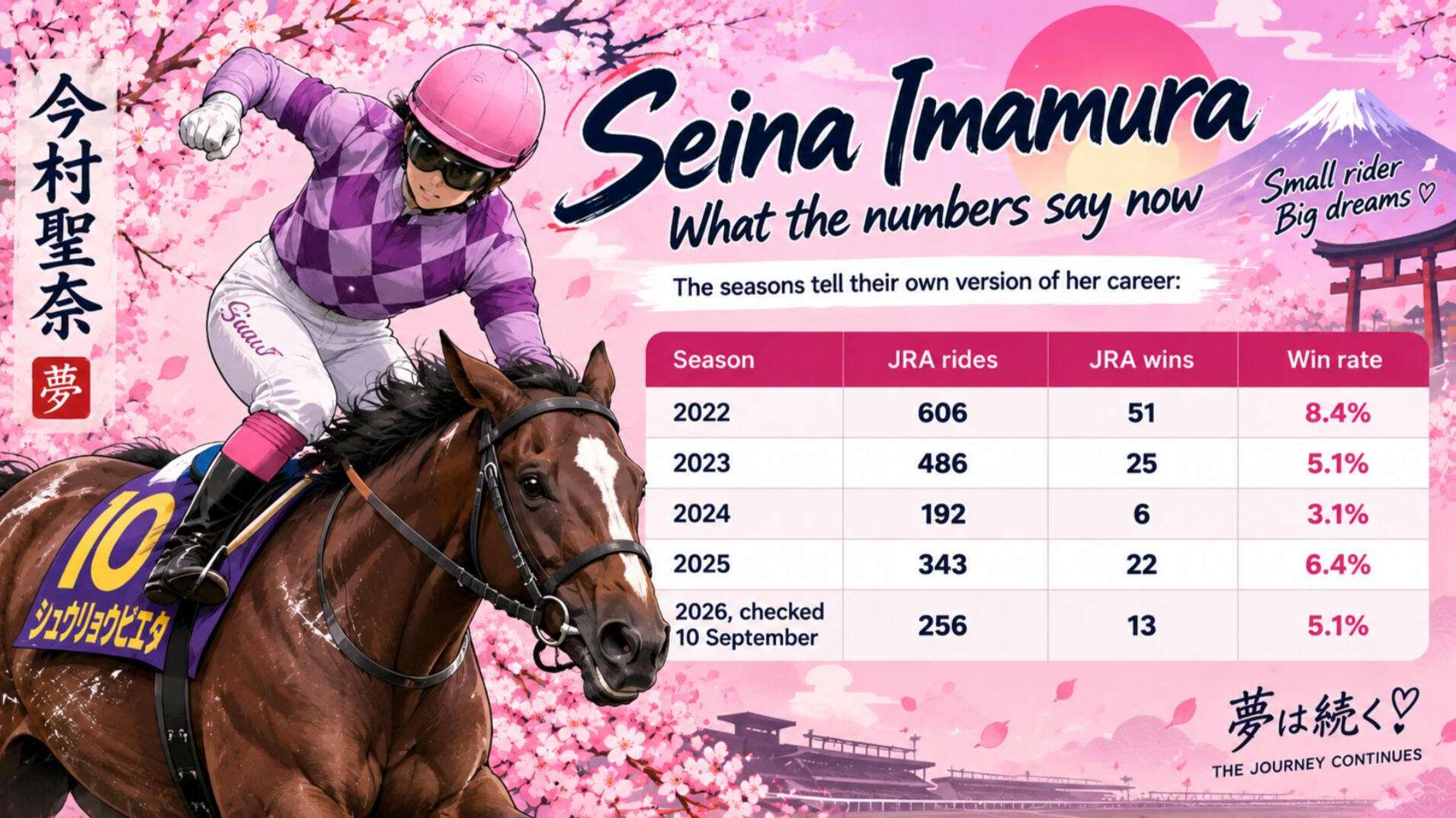
By the end of 2022, she had ridden 51 JRA winners from 606 rides and finished as the leading jockey at Niigata with 19 victories.
It was an outstanding start to her career.
Suspension, Injury and a Drop in Winners
The following two seasons were much tougher.
In May 2023, Imamura was one of six young jockeys suspended by the JRA for improper smartphone use. She received a 30-day ban after breaking strict rules covering phones and communication around race meetings.
The offence concerned improper phone use. There was no finding of race-fixing or a betting offence.
Imamura returned to riding and finished 2023 with 25 JRA winners, less than half her total from the previous season.
Things became harder again in 2024 when she fell during training at Hakodate and dislocated her right shoulder. Surgery followed, along with a period away from racing.
She managed only six JRA winners from 192 rides that year.
Working Her Way Back
There were better signs in 2025.
Imamura spent time riding work at Miho, building contacts with more trainers and stables. In May she won the Listed Tachibana Stakes at Kyoto aboard Mui.
Later that year, she reached 100 JRA winners when In Flore won at Niigata. She became only the third woman to reach that mark after Nanako Fujita and Manami Nagashima.
Imamura had reached 100 in fewer rides than either of them.
Her own reaction was telling.
“I’ve kept you waiting a very long time,” she said.
After riding 51 winners in her first season, she clearly felt the century should have arrived sooner.
Juryoku Pierrot and the Japanese Oaks
The horse who took Imamura back to the top level was Juryoku Pierrot, trained by Ryo Terashima.
By spring 2026, the filly had earned her place in the Japanese Oaks, one of Japan’s major Classics, run over 2,400 metres at Tokyo.
Imamura had only ridden in a Grade 1 twice before.
Trainer Terashima advised her to keep an eye on Christophe Lemaire, one of the leading jockeys in Japanese racing and a rider with a superb record at Tokyo.
Imamura settled Juryoku Pierrot towards the rear and waited before making her move in the straight.
At the finish, she beat Lemaire’s mount Dream Core by a neck.
“It’s like I’m dreaming!” Imamura said afterwards.
The victory made her the first Japanese woman to win a JRA Grade 1 race and gave Terashima his first success at that level too.
What Comes Next?
By September 2026, Imamura had recorded 117 JRA winners from 1,883 rides.
Her best season by total victories is still her first, when she rode 51 winners, but the Japanese Oaks is clearly the result that matters most.
Imamura is still only 22 and remains an active jockey. Earlier in her career, when asked which race she most wanted to win, she named the Arima Kinen, one of Japan’s biggest races.
She has already made history once.
Now the question is how many more major victories she can add to it.


